…………………………………………………………………………………………………………………………………….
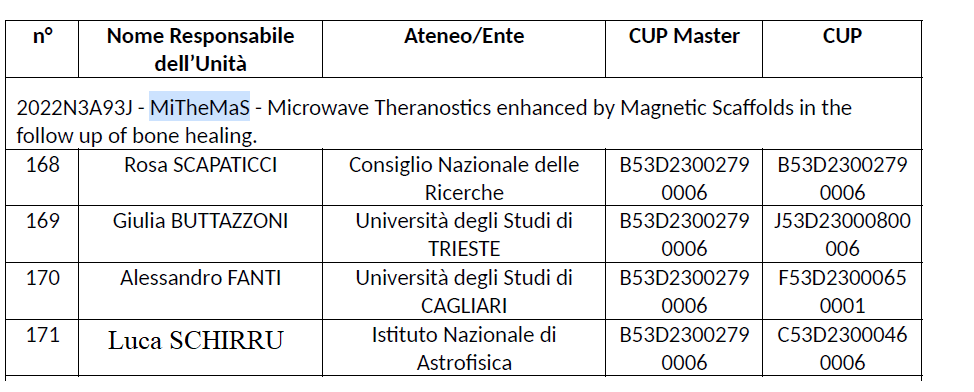
The MiTheMaS consortium is constituted by four research units:
- Consiglio Nazionale delle Ricerche – Istituto per il Rilevamento Elettromagnetico dell’Ambiente – IREA-CNR
- Università di Trieste – UNITS
- Università di Cagliari – UNICA
- Istituto di Astrofisica – INAF-OAC
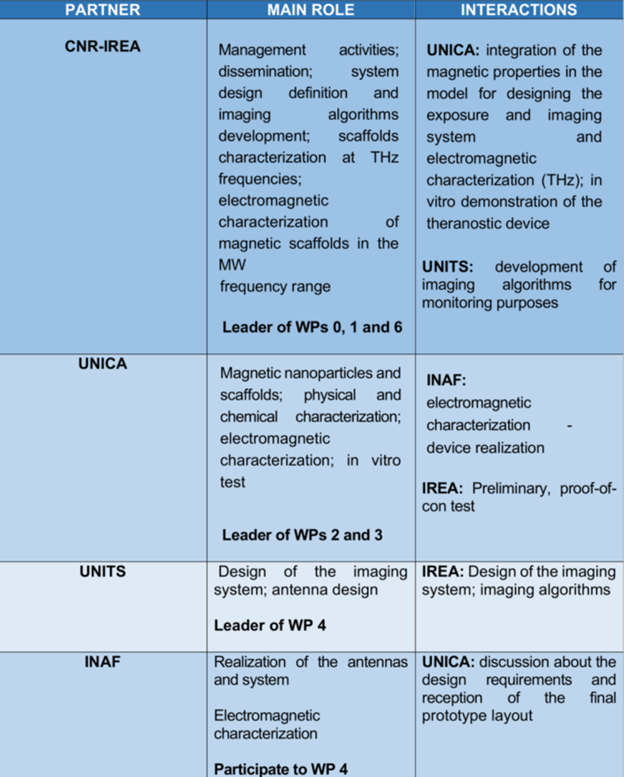
Table 1. Roles and integration of the research units.
By gathering researchers with different backgrounds, the consortium will provide the multidisciplinary knowledge required by the project’s activities, which involves electromagnetics, signal processing and imaging, bioengineering, materials chemistry, chemical and materials engineering and biology. The role of each unit and integration is summarized in Table 1, while the specific contributions and expertise are detailed in the following.
…………………………………………………………………………………………………………………………………….
IREA-CNR

IREA-CNR will provide the expertise in electromagnetic diagnostics techniques and model-based imaging, as well as in the design of MW imaging systems for biomedical applications. IREA-CNR has also pioneered the use of MNPs as a modulated contrast agent for MWI of cancer and performed its laboratory validation on phantoms. The IREA-CNR team has a strong expertise in inverse scattering techniques, which are at the basis of microwave imaging algorithms development. In particular, several approaches for MWI monitoring of time-evolving processes have been proposed by the IREA group. The two researchers of the IREA-CNR unit will be supported by a 12-month research fellow, specifically hired for the project, who will take part in the numerical validation of the system, as well as in the experimental proof-of-concept. The facilities available at CNR-IREA which will be exploited for the project activities are:
- VNA at 8 channels with cables and E-cal kit
- Electromagnet with a power supply to modulate MNP response
- Keysight probe high temperature
- Signal generator
- CST studio for electromagnetic simulations in the design phase
- High performance workstation for the processing of data
…………………………………………………………………………………………………………………………………….
UNITS

The UNITS team involved in the MiTheMas project is composed by two researchers. It has a long experience in the field of antenna synthesis. In particular, an important focus of its research activity concerns the development of deterministic algorithms for the synthesis of antenna arrays. Such algorithms are usually suitable for arrays of arbitrary geometry, thus including cylindrical ones, which are expected to be used in the MiTheMas project. Additionally, the geometry of the array (precisely, the number of radiating elements and their positions on the antenna) can be optimized, along with the element excitations. Moreover, additional constraints are considered, such as the control of the near-field and of the polarization. The developed algorithms allow the designer to consider arbitrary active element patterns of the elements during the synthesis process. Thus, they are suitable for considering printed antennas and for including the mutual coupling effects among elements. For the project activities, the UNITS team will exploit the following facilities: high performance workstations for running the developed algorithms of synthesis (using MATLAB); CST for the simulations of the designed antenna array.
…………………………………………………………………………………………………………………………………….
UNICA
The UniCa includes researchers of the following groups:
– group of Applied Electromagnetics (EMA) from the Depart. of Electric and Electronic Engineering (DIEE)
– group of Fundamentals of Chemical Engineering (FCE) from the Depart. of Mechanical, Chemical, and Materials Engineering (DIMCM);
– group of Molecular Virology (LMV) from the Depart. of Life and Environmental Sciences (DLES);
– group of Clinical Orthopedics, from the Depart. of Surgical Sciences, which will be not directly involved but it will support the UniCa unit.
…………………………………………………………………………………………………………………………………….
INAF-OAC

The INAF-OAC research Unit is principally composed by two experts in the fields of electromagnetic and electronic simulations and design of components and systems. Their experience is directly related to the management, research and development of the receivers and of the non-contact measuring and control systems used in the Sardinia Radio Telescope. Another very specific sector where the team of the INAF-OAC has a lot of experience is in the radiofrequency monitoring and in the cryogenic design and construction of dewars and vacuum systems for the radio astronomical receivers. The team can involve in the project a very competent and well-prepared technical staff composed by electronic, radio and mechanical technicians. To perform their work the INAF-OAC staff has the availability of a very modern and well equipped electronic and mechanical laboratories. The mechanical laboratory is equipped with CNC lathe and milling machines, and the electronic one with Vector Network Analysers, Signal generators, Spectrum Analysers, Oscilloscopes, up to the highest frequency of 110 GHz. In those laboratories they can construct some very precise and accurate mechanical parts and systems and mount and test electronic and microwave components and circuits. The INAF-OAC team has the know-how, experience and instrumentation to manufacture the antennas developed in the MiTheMaS project. The long experience in antennas and systems manufacturing gives INAF-OAC a good confidence about the final result.
…………………………………………………………………………………………………………………………………….